A body fat calculator gives you a rough body fat percentage without a lab or a special scale. This one uses the U.S. Navy method, which needs only a tape measure, your height and a few minutes.
Body fat percentage says more about body composition than weight alone, since two people at the same weight can carry very different amounts of muscle and fat. The result is an estimate and is not medical advice.
How to use the body fat calculator
- 1
Choose male or female
The Navy method uses a different formula for each, and women add a hip measurement.
- 2
Enter your height
Measure barefoot, standing straight, in centimeters.
- 3
Enter neck and waist
Use the measuring guide below so each number is taken at the right spot.
- 4
Women: enter hips
Measure around the widest part of the buttocks.
- 5
Read your result
You get an estimated body fat percentage and the category it falls into.
How do you measure your neck, waist and hips for body fat?
Use a flexible tape measure, snug against the skin without pressing in, ideally in the morning before eating. Stand relaxed and don’t pull your stomach in.
Neck: just below the larynx (Adam’s apple), with the tape sloping slightly down toward the front.
Waist, men: horizontally at the level of the navel, at the end of a normal breath out.
Waist, women: at the narrowest point of the waist, at the end of a normal breath out.
Hips, women: around the widest part of the buttocks, feet together.
Measure each spot two or three times and use the average. When you repeat the measurement weeks later, use the same tape, time of day and technique, otherwise the change you see may just be measuring noise.
How is body fat percentage calculated with the Navy method?
Body fat is calculated from circumference measurements and height using the U.S. Navy formulas, with every measurement in centimeters and log10 meaning the base-10 logarithm:
Men: 495 ÷ (1.0324 − 0.19077 × log10(waist − neck) + 0.15456 × log10(height)) − 450
Women: 495 ÷ (1.29579 − 0.35004 × log10(waist + hip − neck) + 0.22100 × log10(height)) − 450
Example: a man 180 cm tall with a 38 cm neck and an 85 cm waist comes out at about 16% body fat, in the fitness range. A woman 165 cm tall with a 32 cm neck, 72 cm waist and 98 cm hips comes out at about 27%, in the average range.
Because the formula only sees circumferences, it can misread people with a very muscular neck or an unusual fat distribution. It works best for tracking change over time in the same person.
What is a healthy body fat percentage?
By the American Council on Exercise (ACE) ranges the calculator uses, fit women are at 21–24% body fat and fit men at 14–17%, with average at 25–31% for women and 18–24% for men.
Essential fat: women 10–13%, men 2–5%
Athletes: women 14–20%, men 6–13%
Fitness: women 21–24%, men 14–17%
Average: women 25–31%, men 18–24%
Above average: women 32% and up, men 25% and up
Essential fat is the minimum the body needs to function normally, not a goal. These ranges are general and do not adjust for age, so use them as a reference point rather than a verdict.
How do coaches use body fat percentage with clients?
Coaches use body fat percentage as one trend among several, next to weight, progress photos and strength, to judge whether a client is losing fat or gaining muscle rather than just changing weight.
Watch the trend. A single reading says little. The same measurement every few weeks shows the direction.
Explain a stuck scale. When weight holds steady but the waist shrinks, the client is usually recomposing, and the number helps them see it.
Set nutrition targets. Body composition helps decide between a fat loss phase, maintenance or a muscle gain phase, and the calorie and macro targets that follow.
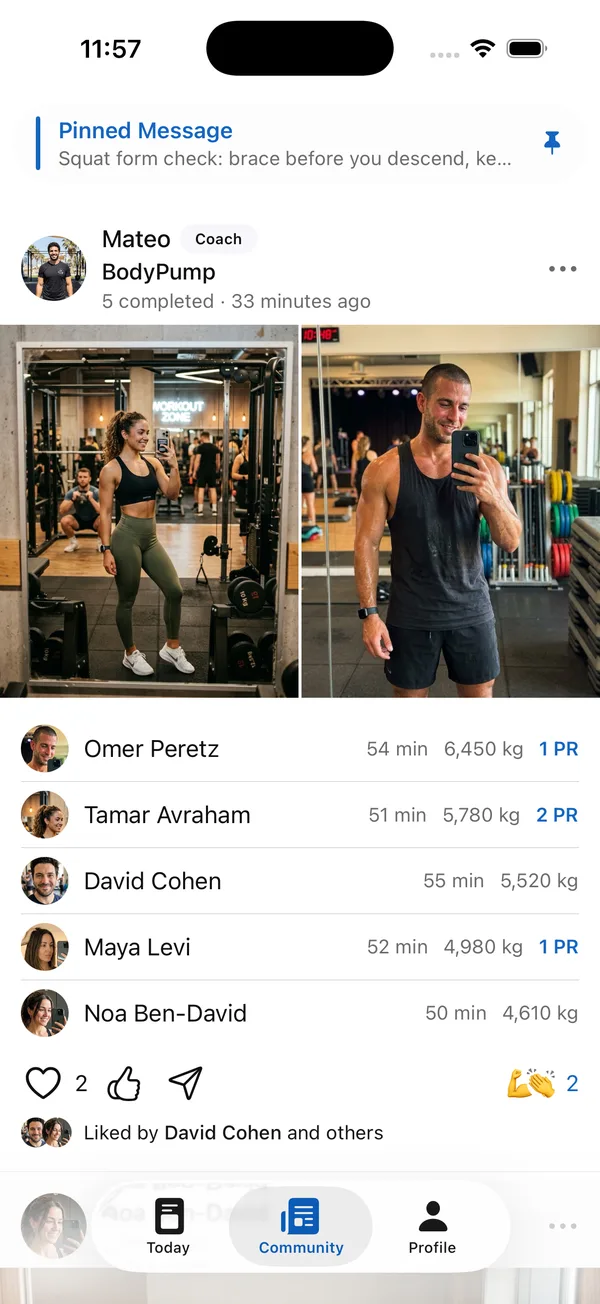
On the Coach+ coaching platform, clients send weekly check-ins with progress photos from your own branded app, and log food by barcode, photo or search against the macro targets in the meal plan you build. That gives you the full picture around the body fat number.