This target heart rate calculator estimates your maximum heart rate from your age and turns it into five training zones in beats per minute (bpm). Add your resting heart rate and the zones are calculated with the Karvonen method, which adjusts them to your own fitness level.
Results are estimates for healthy adults and not medical advice. If you have a heart condition, take medication that affects heart rate (such as beta blockers) or are starting exercise after a long break, ask a doctor which intensities are right for you.
How to use the target heart rate calculator
- 1
Enter your age
The calculator uses it to estimate your maximum heart rate as 220 − age.
- 2
Add your resting heart rate (optional)
Count your pulse for a full minute in the morning, before getting out of bed. Average three or four mornings for a steadier number.
- 3
Read your five zones
Each zone shows a low and high heart rate in bpm. With a resting heart rate the zones use the Karvonen method; without it they are a straight percentage of max.
- 4
Train in the zone that fits the session
Easy runs and recovery sessions sit in zones 1 and 2; intervals push into zones 4 and 5.
How is target heart rate calculated?
Target heart rate is calculated from your maximum heart rate (220 − age), either as a plain percentage of max or, if you enter a resting heart rate, with the Karvonen formula.
Max heart rate = 220 − age.
Percentage of max: target = max heart rate × intensity %.
Karvonen method: target = (max heart rate − resting heart rate) × intensity % + resting heart rate. The part in brackets is called heart rate reserve.
Example: a 40-year-old has an estimated max of 180 bpm. Zone 2 (60–70%) as a percentage of max is 108–126 bpm. With a resting heart rate of 60, the Karvonen zone 2 is (180 − 60) × 0.6 + 60 = 132 to (180 − 60) × 0.7 + 60 = 144 bpm.
Karvonen zones come out higher at the low end because they start from your resting heart rate instead of zero. That usually matches how the effort feels better, especially for fit people with a low resting heart rate.
What are the 5 heart rate zones?
The five heart rate zones split your effort from very easy to maximal, each covering 10% of your max heart rate or heart rate reserve.
Zone 1 (50–60%): very light. Warm-ups, cool-downs and recovery sessions.
Zone 2 (60–70%): light. You can hold a full conversation. Most aerobic base training happens here.
Zone 3 (70–80%): moderate. Breathing is harder and you can only speak in short sentences. Tempo work.
Zone 4 (80–90%): hard. Only a few words at a time. Threshold intervals.
Zone 5 (90–100%): maximal. Short all-out efforts you can hold for seconds to a couple of minutes.
How accurate is 220 minus age?
220 − age is a population estimate, not a measurement. It describes the average for an age group, and individual people of the same age can sit 10 or more beats per minute above or below it.
If your zones feel clearly wrong, for example zone 2 feels like a hard effort or zone 5 feels easy, trust the effort and the talk test over the number. A lab test or a supervised maximal effort gives a real max heart rate, and you can then recalculate the zones from it. Any target heart rate calculator based on age has the same limit.
How coaches use heart rate zones with clients
Personal trainers and online coaches use zones to make cardio prescriptions specific. "30 minutes of zone 2" is clearer for a client than "easy cardio", and it stops the common mistake of running every session at a moderate, medium-hard pace.
Write the bpm range, not just the zone. Clients rarely remember percentages. Put their actual numbers in the program.
Pair zones with the talk test. Age-based zones can be off, so teach clients what each zone should feel like.
Recalculate when resting heart rate drops. As fitness improves, resting heart rate often goes down and the Karvonen zones shift with it.
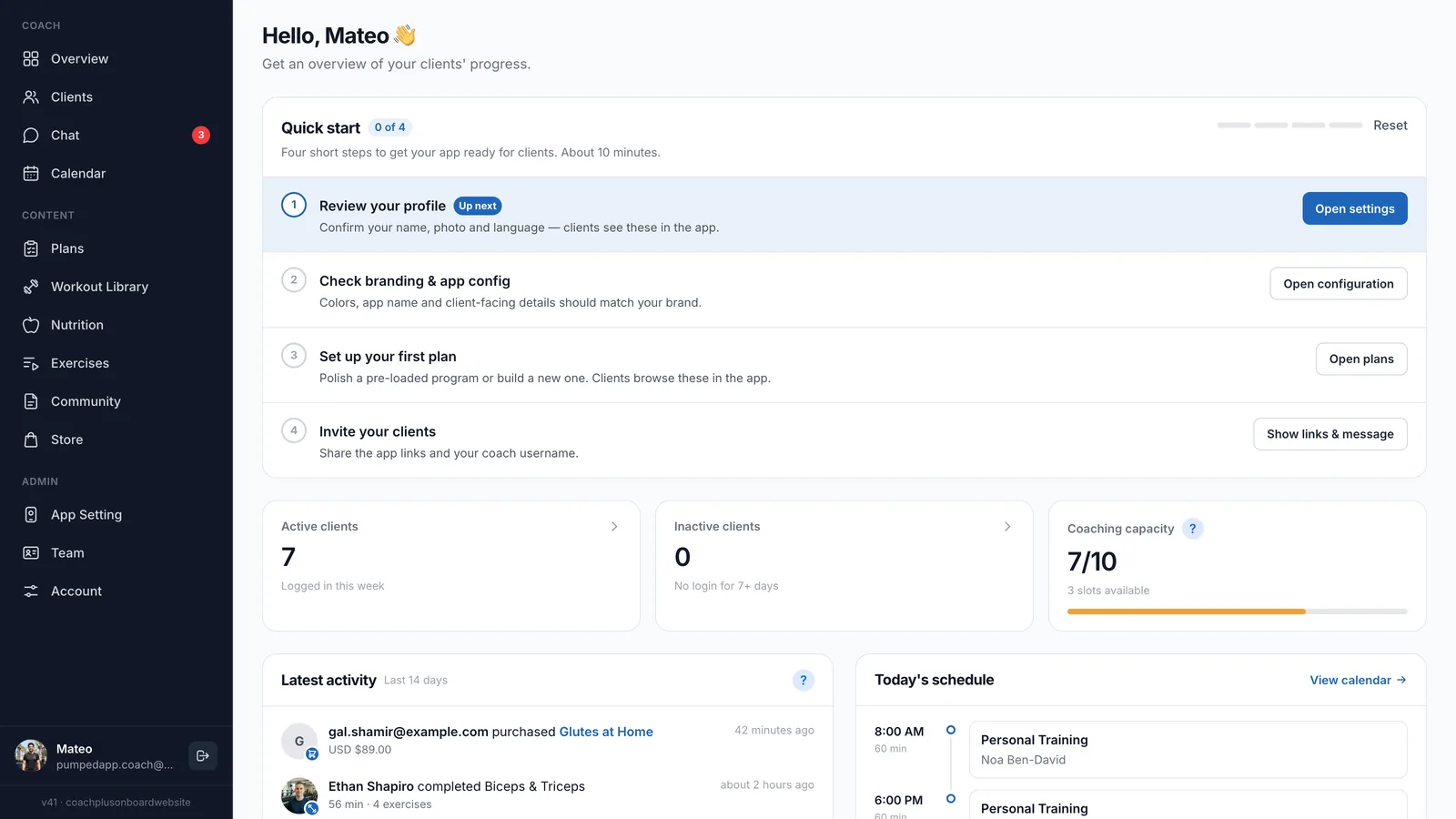
On the Coach+ coaching platform, you build training programs with cardio sessions alongside strength work, and clients log every workout in your branded app. The AI assistant can draft a program for you to review before sending, and weekly check-ins with progress photos let you adjust the plan as the client gets fitter.