Personal trainer prices in Israel vary more than most people expect: the same hour can cost 150 shekels in a gym in one city and 400 at home in Tel Aviv. The price depends on where the session happens, how many people share it, how many sessions are bought upfront and how much follow-up comes between sessions.
This guide collects the published numbers we could verify in October 2026, names the source and date for each, and separates them by format: one-on-one sessions, packages, couples and small groups, and online coaching. The last part is for coaches deciding where to place their own price.
How much does a personal trainer cost in Israel per session?
A single one-on-one session of 45 to 60 minutes usually costs between 150 and 350 shekels, with home sessions and well-known Tel Aviv trainers at the top of the range. The published figures:
- Midrag price guide (checked October 2026). 150 to 300 shekels per 45 to 60 minute session in general, 150 to 250 in a gym and 200 to 400 at the client’s home.
- Bizportal, July 2026. 200 to 400 shekels per session at home or in a studio, and 150 to 300 inside a gym, on top of the gym membership.
- Bizportal, September 2026. Independent trainers charge 180 to 350 shekels per session, in-demand trainers in Tel Aviv 280 to 400. A gym club charges the client 180 to 250 while paying its salaried trainer 60 to 100.
- Dapei Zahav gym price list (checked October 2026). 100 to 200 shekels for a personal session, the lowest range of the four sources.
None of these is a large survey of trainers, so treat the ranges as a guide to the market, not a rule.
How much does a personal training package cost?
A card of ten sessions usually costs about 1,700 to 2,300 shekels in a gym or studio, which brings the price per session down to roughly 170 to 230 shekels.
- Bizportal, September 2026. Ten-session cards at 1,800 to 2,300 shekels, or 180 to 230 per session.
- Midrag. Example packages of 3 and 5 gym sessions at 180 shekels each, 10 gym sessions at 1,700 and 10 home sessions at 2,300.
- Dapei Zahav. 1,500 to 2,500 shekels for a ten-session card.
How much do couples and small-group sessions cost?
Sharing a trainer cuts the price per person. Bizportal (July 2026) puts a paired session at about 125 to 225 shekels per person and a small group at about 50 to 120 shekels per participant. Its September 2026 article reports 70 to 80 shekels per participant for groups of three to six. Midrag lists couples sessions at 200 to 400 shekels per session for both people together.
How much does online coaching cost in Israel?
Online coaching in Israel is sold as a monthly fee, and the published figures start at a few hundred shekels a month. We found no independent survey, and both sources below are businesses with something to sell, so read them as indications only.
- YGL Sport blog, April 2026. The fitness equipment retailer lists an online trainer at 300 to 800 shekels a month for a program and follow-up without in-person sessions. It gives no source for the figure.
- Ofek Zaramati’s site (undated, checked October 2026). This online coach describes three levels: 300 to 600 shekels a month for a mostly generic plan sent as a PDF, 700 to 1,300 for a more tailored program with partial follow-up, and 1,400 to 2,500 for close coaching with regular adjustments.
What both sources agree on is that the price follows the amount of personal attention, not the number of workouts. One-off training programs without follow-up are cheaper again, but we found no reliable Israeli figure for them.
What does a personal trainer cost per month?
One in-person session a week costs roughly 650 to 1,500 shekels a month, based on 150 to 350 shekels a session and about 4.3 sessions a month (our calculation). Bizportal (July 2026) puts the same habit at about 10,400 to 20,800 shekels a year, and two sessions a week at about 20,800 to 41,600. That is why online coaching and small groups are the usual next step for people who want ongoing guidance at a lower monthly cost.
What affects the price of a personal trainer?
- Location. Home sessions cost more than gym sessions, and Tel Aviv prices sit at the top of the range.
- Gym membership. A session inside a gym is cheaper per hour, but the client usually pays a membership on top.
- Package size. Buying ten sessions upfront lowers the price per session.
- Number of people. Couples and small groups split the cost between participants.
- Experience and specialty. Rehab, pregnancy, older adults or competition prep often cost more than general fitness.
- What happens between sessions. Nutrition guidance, check-ins and messaging add value and time, and the price reflects it.
How should a coach position their price?
Start from your own numbers, then use the market ranges to check where you land. Competing on the lowest price fills your week without paying for it.
- 1Work out your floor priceUse the free online coaching price calculator for monthly clients, or the personal training package calculator for session cards. Both start from income target, costs and capacity.
- 2Place yourself in the rangeA new trainer in a gym sits lower; a specialist who travels to clients in central Israel sits higher. Pick the position your experience and results support.
- 3Sell attention, not volumeBuild tiers that differ in follow-up: program only, standard coaching with a weekly check-in, and a premium tier with calls or in-person sessions.
- 4Show what is includedWrite the session length, what happens between sessions, the reply time and whether the price includes VAT. A clear offer is easier to say yes to than a cheap one.
For the full pricing method with a worked example, see our guide on how much to charge for online coaching.
How Coach+ supports a higher-value offer
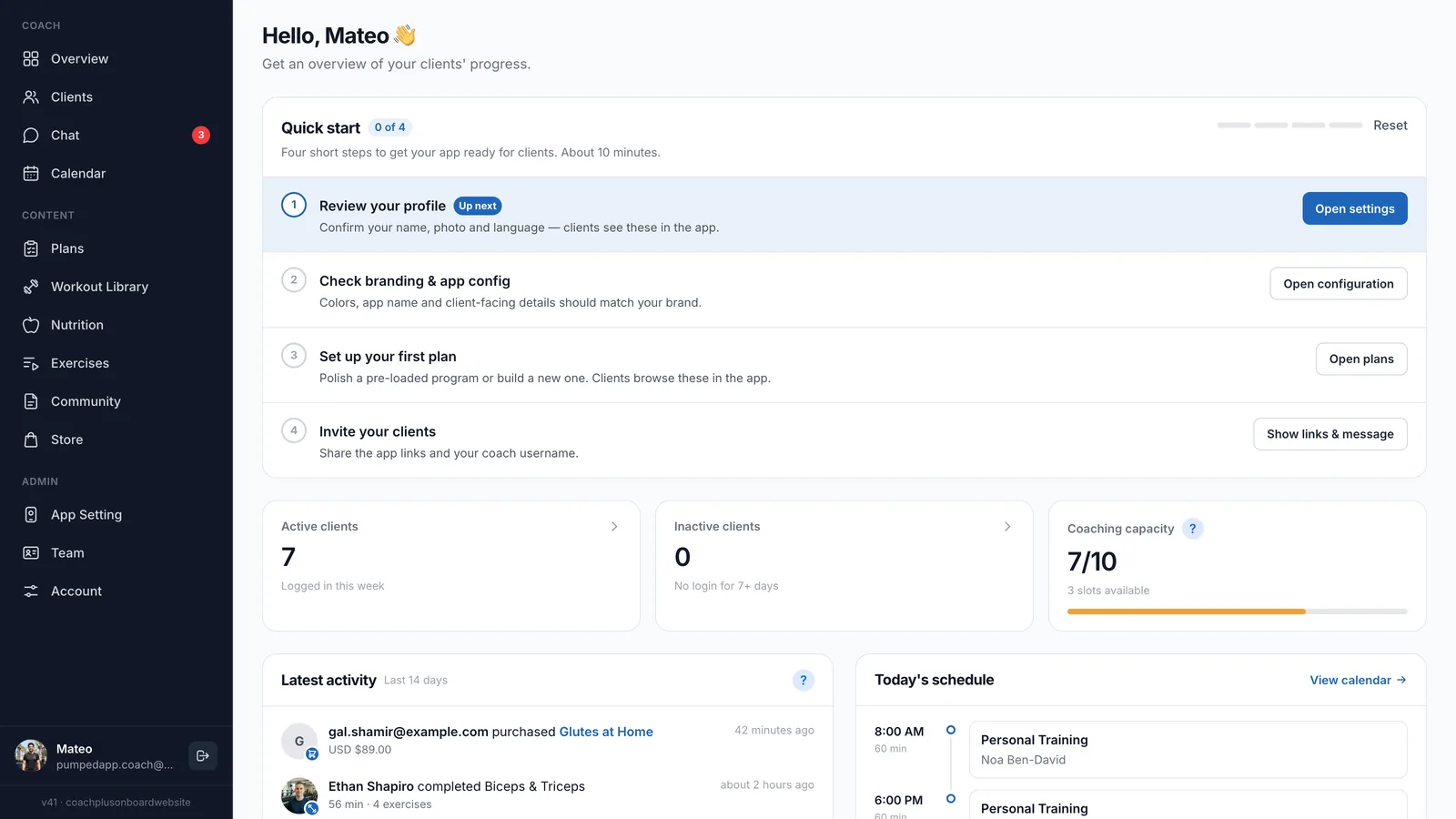
The Coach+ coaching platform helps coaches deliver the follow-up that justifies a monthly price, for online clients and between in-person sessions alike.
- Each client gets your own branded app with workouts, demo videos, set logging and meal plans.
- Weekly check-ins with progress photos and messaging with push notifications, all on the client’s profile in your dashboard.
- A calendar where clients book sessions themselves, for hybrid and premium tiers.
- A storefront for program-only offers with 0% commission, and a fixed monthly price per plan rather than per client.